How big is your baby?
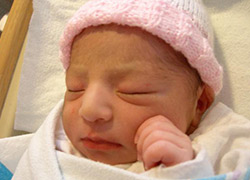
This week your baby will be weighing around 91/4 pounds and measuring 211/4 inches if he/she was of average size at birth.
At about this time your baby may begin to recognize your face and voice. He/She may open and close his/her mouth or bob his/her head when you talk. He/She may even respond to voices with his/her own sounds in response as he/she begins to connect to what is heard and seen.
When your baby is supported he/she can hold his/her head steady for a brief period of time, even if it still a little wobbly. Baby can also probably lift his/her head for a brief period when lying on his/her stomach. To help develop and strengthen the neck muscles, place baby on his/her tummy in many different positions throughout the day when awake, both on the back and tummy.
Your baby will also begin to manually grasps and release objects such as your finger and if his/her hand finds its way to his/her mouth then he/she will begin sucking and mouthing the fingers or fist.
You may also notice that he/she is starting to stretch out and not spend as much time in the fetal position. He/She may arch his/her back and throw out his/her arms and legs, and even twist from side to side.
You baby can now see clearly from 18 inches, but doesn't have much control over his/her muscles, so at this stage he/she can at best wave an arm in the direction of what he/she sees.
Baby Development Milestones This Week
Physical Development
- Actions become more voluntary and reflexes begin to disappear
- May bat or push at objects
- More easily calmed by a female voice
Mental & Social Development
- Memory for objects continues to grow in strength
- Can quiet him/herself by sucking on pacifier or fingers
- Quiets when held or sees faces and voices
- Prefers to watch person than an object
Bathing Baby
Most parents enjoy sharing their bathtub with their baby, and so you might as well. If you are going to introduce your baby to "the big tub" then there are certain precautions you will need to take to keep baby safe.
Place a rubber mat on the bottom of the tub so that your baby will not slip
Have your "baby bathing tools", such as shampoo and soap with in easy reach
You may want to wear cotton gloves to ensure that you have a good grip on him/her.
Make sure the bathroom is warm, but not too hot. Around 75F 23.8C is usually good.
When placing baby into the tub, let his/her feet go in first. If he/she objects, remove him/her immediately.
Support his/her head while you wash him/her
Don't stay in the water too long
Keep the temperature of your water heater below 120F (48.8C) to prevent accidental scalding
Take baby out of the tub first, wrapping him/her in a towel to your partner before you get out.
NEVER leave baby unattended in the tub!
Feeding Your Baby.
By the fifth week your baby is settling into a feeding routine, and should be feeding 6-8 times per day and taking in 2-5 ounces with each feed.
If you are breastfeeding you will notice that your feeding supply is well established.
To ensure that your baby is doing well, you can count the number of wet diapers. Usually 6 a day is good. Also the weight gain and growth will tell you that baby is doing well.
Baby Care
Stimulating Baby's Gums
It is never too early to help your baby develop strong and healthy gums for the teeth which will push through later.
You can do this by wiping his/her gums with a damp washcloth or gauze several times during the day and before bed time.
This will also help later, as he/she will be used to having his/her mouth cleaned, so it will be easier to get into the routine of cleaning teeth.
Hiccups
Hiccups is a contraction of baby's diaphragm, which separates the chest and abdominal cavities. It is not uncommon for a baby to have hiccups, and you may even have experienced your baby having hiccups while still in your womb.
There aren't really any ways in which to prevent hiccups, or even stop them for a matter of fact either. Hiccups usually occur after feeding, and in particular after burping. The only time you should worry about hiccups is when they prevent baby from eating or sleeping.
Dehydration
Dehydration occurs when baby doesn't take in enough fluids, or looses too much fluid from his/her body. It may occur if you are not breastfeeding properly, or not producing enough milk. It may also arise from vomiting or diarrhea. It may also occur during the hot summer months when your baby becomes overheated and does not receive enough fluid to compensate the overheating
Sign to Look For:
Baby's coloring becomes grayish
His/Her mucus membranes become dry
Urination decreases. (Your baby should have 6-8 wet diapers per day)
Sunken Fontanel (Soft part on top of the head)
Rapid pulse
Appears to be sluggish
Preventing Dehydration:
Keep your baby out of the sun.
Ensure he/she drinks plenty of fluids
Dress baby appropriately for the weather.
When to Call You Pediatrician
Baby hasn't had a wet diaper in 6-8 hours
has been vomiting for more than 12 hours
Has passed more than eight diarrhea stools in 8 hours
Has a dry mouth and cries without tears
is inconsolable
seems unusually drowsy or sleepy
has a sunken fontanel
Toys and Play
Nursery Rhymes and Conversations
If you have recordings of nursery rhymes to play for baby, then you should play them as he/she may enjoy the rhythmic cadence. Otherwise you can recite some from a book.
You could also make a hand puppet from an old sock and use it to talk to your baby in a high singsong voice.
Rattles Rings and Noisy Things
Because your baby is now beginning to develop his/her grasping technique, you may want to let him/her play with some safe rattles or rings. They come in all sorts of shapes and sizes, and different materials.
Make sure that the toys don't have small parts, such as eyes, that could come loose.
House Tour
Take your baby for a tour of the house while holding or carrying him/her. Watch to see what objects interest him/her and point them out and talk about the objects.
When you do your routine chores around the house keep your baby close and talk or sing while doing them. Describe your activities to him/her, as this interaction will stimulate him/her and introduce him/her to household objects and tasks.
Quick Tips For This Week
Baby may be sleeping for as long as 7 hours a night by this time, if he/she weighs at least 11 pounds and has no digestive problems.
Sign up now, and recieve Weekly updates on how your pregnancy & your baby are developing. Including pictures, nutritional advice, info on symptoms and complications and so much more!
Stages Of Labor
We have broken the different stages of labor up into 3 separate stages, each having their own experiences. For first time pregnancies the average duration of pregnancy is around 37 weeks and labor lasts for around...
hCG Levels
During the course of your pregnancy your hCG levels will increase and decrease, with the levels doubling on average every 30-31 hours until they peak, usually around the 9th and 10th weeks.....
Ectopic Pregnancy
During the first two weeks of a normal pregnancy when conception takes place, the egg would be fertilized inside....
Asthma While Pregnant
It is not at all uncommon for some women to experience a very severe itching in the last trimester of their pregnancy. In some cases, where the itchiness is....