


Your Baby Development: 3 Weeks Old
Bathing Baby | Baby Care | Colic | Toys and Play
How big is your baby?
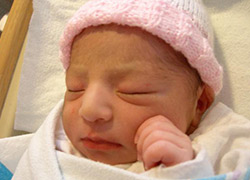
This week your baby will be weighing around 8 1/2 pounds and measuring 20 3/4 inches if he/she was of average size at birth.
Your baby is adapting to his/her new place and family, just as you are now adapting to having him/her in your family. He/She would have accomplished many new thing this week, such as lifting his/her head for a few seconds, turning her head from side to side when he/she is on his/her tummy, etc.
Sucking is satisfying to a baby and some may require more than others. It is comforting and soothing to him/her and so you may want to offer him/her a pacifier to suck one as at this stage he/she may not be able to find his/her mouth.
Your baby may begin to make more eye contact with you, when you hold him/her in your arms, or talk and sing. You may notice that he/she will gazer longer at your face than anyone elses. You may also wish to introduce new and bolder objects.
Your baby is now sleeping 16-18 hours per day, sleeping 3-4 hours at a time, but his/her schedule may still be erratic.
Baby Development Milestones This Week
| Physical Development
- Thrusts our arms and legs in play
- Can lift head for brief period
- May dig heels into mattress, then thrust with legs
- Coordinates eyes sideways when looking at an object or light |
Mental & Social Development
- Has vague and impassive expression during waking hours
- Prefers patterns
- May calm when you speak gently to her and hold her upright against your shoulder
- Makes eye contact
- Adjusts posture to body of person holding him/her |
|
Bathing Baby : My Favorite Play Time!
By the third week you baby's umbilical cord should have fallen off, and it is now time to have his/her first real bath.
How often should you bath your 3 week old baby? Well, you may hear conflicting opinions about this, some may say 2-3 times per week, and others may say daily. If you have any questions on bathing your baby, you should consult your pediatrician.
To begin the bath time ritual, gather all your "equipment"
before you start bathing your baby. Once your baby is in the
bath you CAN NOT be distracted for even a second.
Fill a tub, baby tub or kitchen sink, with
a few inches of warm water. It is important that you make
sure that it is not to hot, you can do this by placing the
inside of your forearm into the water to test the temperature.
You may want to put a large terry towel on the bottom of the
tub for your baby to sit on to help prevent him/her form slipping.
Undress your baby, place your left hand under his/her shoulder
with your fingers under the left armpit and support with your
bottom right hand. Slowly lower him/her into the water onto
the terry towel.
Begin by washing his/her face then work your way down the
body and remember to clean the genital area from front to
back, to help prevent infections. Remember to keep wiping
the warm water over his/her body while you wash.
Once you have washed his/her body, it is time for the shampoo.
You should only need to wash his/her hair once or twice a
week. Use a small amount of baby shampoo to wash the hair
and use a small cup to help make rinsing easier. When rinsing,
raise his/her head, this will help prevent any shampoo from
going into the eyes.
As soon as you have finished you can take him/her out and
wrap him/her in a towel. Gently pat his/her head an body dry,
as this is far gentler than rubbing dry. You can then place
a new clean diaper on and dress quickly to avoid a chill.
Cleaning Baby's Ears
Your baby's ears will produce earwax, just as your do, as
this is a normal body process. Earwax usually falls out, so
you don't need to stick anything into the ear canal to clean
it! You can however clean the entrance to the ear with a washcloth,
but DO NOT try to clean inside!
Baby Care
Being a first time parent can be a scary experience. Everything
is so small and delicate. Everyone will want to give you advice
on how best to care for your baby, but one thing is for sure,
you will know him/her best, and you should trust your instincts!
Babies Cry
Your baby will cry, it is expected, after all it is the only
way in which he/she has to communicate with you. Most babies
cry about 3 hours a day, some more, some less. Your baby will
cry when he/she is uncomfortable, hungry, wet, bored or upset.
As you get to know your baby you will learn why he/she is
crying. You will be able to tell when something is wrong.
If you are concerned about your baby's crying, or nothing
seems to be able to sooth him/her, speak to your pediatrician.
Your baby will loose some weight
Babies are born with extra fluid in them to get them through
the first 3-5 days after birth. Your little one will loose
some fluid, in fact, most babies loose about10% of their body
weight by the 3rd day after birth. If your baby hasn't regained
any weight by your 2nd week checkup, you should speak to your
pediatrician about this.
Spitting Up
Don't be surprised or worried if your baby spits up. In a
new born the muscle that closes the opening to the stomach
may be underdeveloped. However if your baby is projectile
vomiting, when it shoots out with force, then you should consult
your pediatrician immediately.
Coughing and Sneezing
Your baby will cough and sneeze to clear nasal passages of
mucus, dust or other irritants. It may not be a sign of sickness,
it is just a case of it is the only way he/she has to clear
the passages. However, if he/she has a fever or is congested
and this interferes with his/her eating and sleeping, then
you should consult your pediatrician.
Baby's Bowel Movements
What is normal for one baby may not be normal for another.
It all depends on what your baby eats and how he/she deals
with it. Bottle fed babies tend to have 2-3 bowel movements
per day, as opposed to breast fed babies having a bowel movement
after every feed. However, some breast fed babies also only
pass a movement far less. If you baby hasn't passed a stool
in 4 days, as a breast fed baby, or 2 days as a bottle fed,
then you should contact your pediatrician.
Colic
Colic is a condition in which a baby has episodes of sudden
loud crying and fussiness that often lasts for hours. About
20% of babies suffer from colic and it usually sets in about
2 weeks after birth until the baby is 3-4 months old.
Baby may draw his/her knees to his/her chest, pass gas and
flail his/her arms, the tummy muscles will feel hard, and
an attack may stop as suddenly as it starts.
Why Does Colic Occur?
Know one really knows why colic occurs, although researchers
have a few theories as to what may cause it:
- Immaturity of the baby's digestive system, also known
as gastoesophageal reflux (GER)
- Sensitivity to cows milk protein in formula
- Fatigue
- Some foods which a mother may eat, if breastfeeding
What Can You Do?
At this time there isn't really an effective treatment for
colic. Don't give your baby any type of medication to relieve
the pain or to stop the cramping, as this may cause additional
problems. Although you may wish to try one of the following:
- Offer baby the breast or a bottle
- If you are feeding on formula, try using a different one
which is not based on cows milk.
- Carry your baby in a front sling, the closeness and motion
may help to sooth him/her.
- Place your baby across your knees on his/her stomach,
and rub his/her back
- Swaddle your baby
- Massage his/her tummy
It may be difficult, but it is important that you try and
stay as calm and relaxed as possible during a colic attack.
Take turns with your partner at staying with the baby to give
each other a break and some time to relax.
Toys and Play With Your Baby
As you find baby stays awake for longer periods that you
will have much more time for fun and games, and you will also
find that he/she will respond more to your games. Be sure
to watch him/her closely as you will be able to tell when
he/she has had enough. Signs such as the following will let
you know that he/she has had enough:
- He/She looks away
- He/She yawns
- He/She fusses and kicks his/her legs
- General unhappiness
Talk To Your Baby
When you play with your baby vary your tone of your voice.
Try to talk in a high pitched singsong tone of voice. It will
help to speed up the process by which he/she recognized objects
by sounds.
Physical contact continues to play an important part in development
and play. Holding your baby in your arms, or sit on the floor
with him/her in your arms while you talk to him/her and say
his/her name.
Play The Flashlight Game
In a dimly lit room turn on a flashlight and shine it in front
of your baby, never shine it into your baby's eyes! Watch
baby closely as he/she tracks the light as it runs along the
floor. This exercise will help to develop the muscles needed
to follow objects.
Bicycle Exercise
While baby is lying on her back, grasp his/her feet and gently
move his/her legs in a circular motion as if riding a bike.
This exercise encourages toning of muscles and exposes him/her
to rhythm. A couple of minutes is long enough for this exercise.
Quick Tips For This Week
| Keep your baby
from getting your cold or any germs and infections by
washing your hands before touching him/her. Get your other
family members do the same, especially brothers and sisters. |
|